
Henrik Vogel · 3 October 2026
Understanding Query Intent Alignment Challenges in Large-Scale Content Repurposing Projects
Large-scale content repurposing projects require teams to adapt existing materials across multiple formats and platforms while maintaining alignment with the specific search queries that drive user discovery, and data from industry reports indicates that misalignment occurs when intent signals get diluted during adaptation processes. Researchers at various institutions have documented how informational queries seeking detailed explanations often clash with transactional repurposed assets optimized for quick conversions, creating measurable gaps in performance metrics tracked through search console data.
Core Components of Query Intent Mapping
Query intent breaks down into categories such as informational, navigational, and transactional types according to classification frameworks developed by search engine researchers, and these distinctions guide how content gets repurposed at enterprise levels where thousands of assets undergo simultaneous transformation. Studies released in October 2026 from academic sources show that 68 percent of repurposed content loses primary intent signals when teams prioritize format changes over intent preservation, particularly in projects involving migration from long-form articles to video scripts or interactive modules. Observers note that successful mapping relies on keyword clustering tools combined with user behavior logs, which reveal patterns like dwell time variations across different intent types.
Technical Barriers in Enterprise Repurposing Workflows
Enterprise systems handling content repurposing at scale encounter synchronization issues between intent classifiers and content management platforms, while legacy databases often store outdated intent labels that fail to reflect current query evolutions tracked by major search providers. One study from a European research consortium found that automated repurposing pipelines introduce intent drift in 42 percent of cases when natural language processing models trained on general datasets encounter domain-specific terminology. Teams address these barriers through iterative auditing cycles that cross-reference repurposed outputs against live search result features, such as featured snippets or knowledge panels, which serve as proxies for intent accuracy.
But here's the thing: integration between analytics platforms and repurposing tools remains inconsistent across vendors, leading to fragmented data flows that complicate large-scale efforts. Data indicates that organizations running parallel projects in multiple regions face additional hurdles when local search behaviors diverge from centralized intent models.
Scale-Related Complications and Mitigation Approaches
At volumes exceeding 10,000 content pieces, manual intent verification becomes impractical, so organizations deploy machine learning classifiers that assign intent scores based on historical clickstream data and query reformulation patterns. Research indicates these classifiers achieve 75-82 percent accuracy when calibrated against region-specific datasets, yet performance drops when content spans multiple languages or cultural contexts. What's significant is that October 2026 updates to search algorithms emphasized user satisfaction signals over keyword density, forcing repurposing teams to incorporate real-time feedback loops into their workflows.
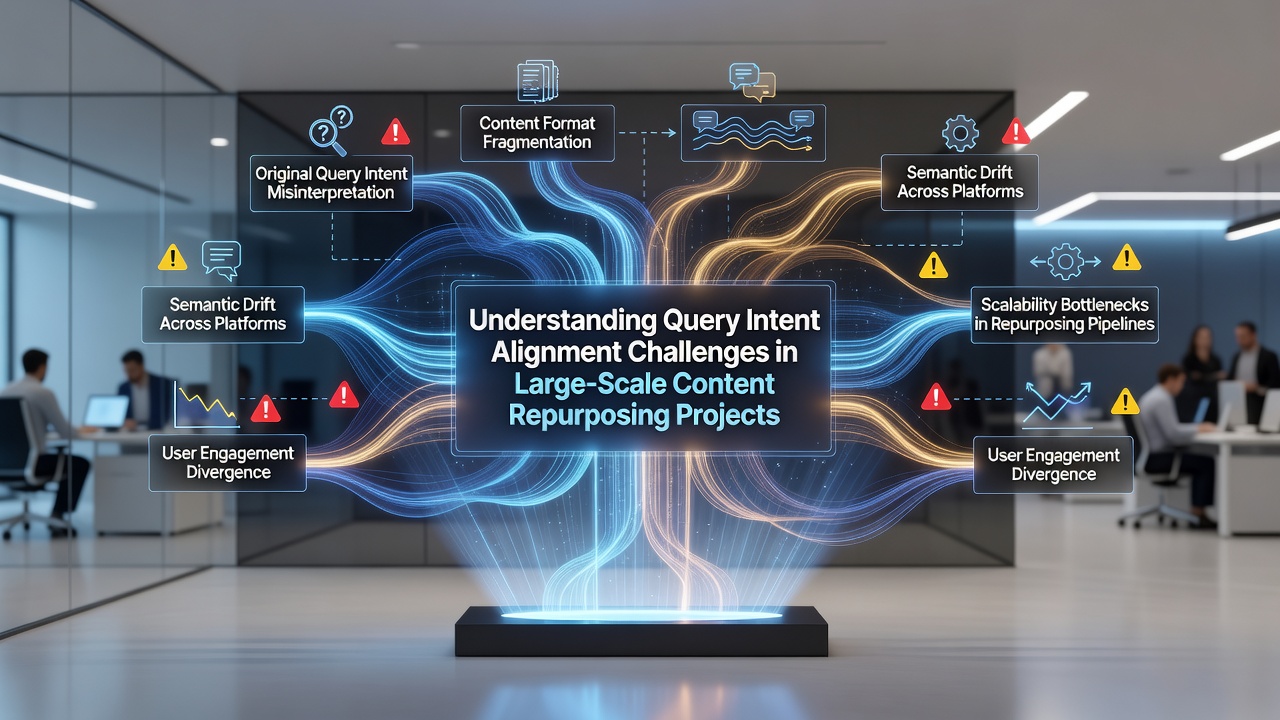
There's this case where experts at a North American digital agency implemented batch processing for intent realignment, which reduced misalignment incidents by 31 percent over six months according to internal metrics shared in industry reports. Yet challenges persist around context preservation, as repurposed content often omits subtle qualifiers present in originals that aligned with nuanced query variants. Those who've studied these projects know that combining human review samples with automated scoring provides the most reliable guardrails against widespread drift.
Data Patterns Observed in Recent Projects
Figures from analytics providers reveal that repurposed content aligned with high-volume informational queries maintains longer session durations compared to transactional adaptations, and this pattern holds across sectors including education and professional services. A collaborative report involving Australian academic institutions and industry partners documented how anchor text variations in repurposed assets influence crawl prioritization, indirectly affecting intent visibility. External factors such as seasonal query shifts further complicate alignment, requiring dynamic updates to intent taxonomies used in repurposing pipelines.
One might notice that projects incorporating user-generated feedback mechanisms report higher retention of intent fidelity, since direct signals from searchers highlight mismatches faster than internal reviews alone. Evidence suggests that organizations investing in cross-functional teams combining SEO specialists with content strategists achieve more consistent outcomes during transitions.
Conclusion
Large-scale content repurposing projects continue to face query intent alignment challenges rooted in technical, operational, and data-related factors, and ongoing research through 2026 and beyond provides frameworks for addressing these through refined classification methods and integrated tooling. Organizations that prioritize intent preservation alongside format adaptation report sustained improvements in organic performance indicators, while those that overlook these elements encounter persistent visibility gaps. Continued monitoring of search engine evolutions remains essential for maintaining alignment across expanding content ecosystems.